

Light-based therapy is not new to dentistry — many practices already know low-level laser therapy (LLLT). Photobiomodulation (PBM) is the broader scientific framework behind it: the controlled, non-thermal delivery of specific wavelengths to support the body’s own repair and comfort processes. [S2]
The ATP38 uses a multi-panel LED configuration with six wavelength bands characterized in peer-reviewed research. Treatment parameters are selected according to the clinical application and protocol. [S1]
Below: where PBM fits across dental workflows, what the research base looks like, and how it compares with the dental lasers you may already know.
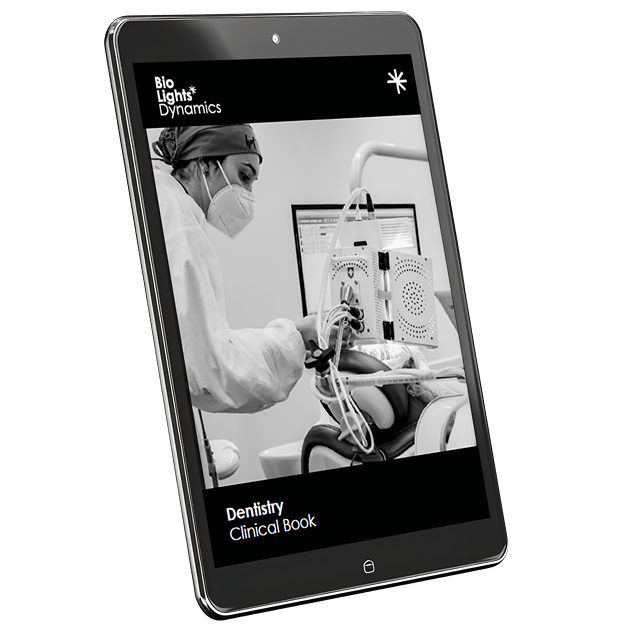
Post-operative discomfort, swelling and tissue recovery are important considerations after extractions and oral surgery. PBM is studied in this setting as a supportive approach for post-operative comfort, swelling and tissue recovery. Its non-invasive delivery format can also support integration into structured post-surgical care protocols.
Research listed on this page examines PBM in the context of implant stability, post-surgical healing and peri-implant tissue recovery. See the dentistry studies below for the clinical evidence.
PBM is studied for pain management and functional support in temporomandibular disorders. The ATP38’s external multi-panel format allows light to be delivered around the temporomandibular region without intraoral access.
Discomfort after adjustments is one of the most common complaints in orthodontic care, particularly with younger patients. PBM’s non-invasive, needle-free profile is studied in this setting as a comfort-support measure — and is easy to explain to patients and parents.
If you have explored laser therapy in dentistry, you already know the principle: therapeutic light, delivered at controlled doses. PBM is the scientific framework both lasers and LED systems work within — research comparing the two indicates that properly dosed LED systems can deliver PBM effectively. [S6]
The practical differences are largely about delivery format. Many dental laser workflows use localized handpieces, while a multi-panel LED platform such as the ATP38 can illuminate broader treatment fields extraorally. Neither format necessarily replaces the other — they can serve different clinical and workflow needs. For a practice evaluating light-based therapy, the question is less “laser or LED?” and more “which delivery format, field size and protocol approach fit the procedures we actually do?”
A modality only helps a practice if it fits the day. PBM sessions with the ATP38 are brief and extraoral: after positioning, the protocol runs according to the device settings. No surgical setup and no consumables per session.
That profile makes PBM schedulable — as a planned post-op series, an adjunct inside TMD programs, or a comfort option after orthodontic adjustments — without displacing production time. Safety practice is the standard PBM discipline: protective eyewear and contraindication screening before treatment.
Is PBM the same as dental laser therapy?
They share the same scientific framework. Laser systems typically treat point-by-point intraorally; multi-panel LED PBM platforms like the ATP38 treat broader fields extraorally with protocol-controlled wavelengths and doses. Research indicates properly dosed LED systems deliver PBM effectively.
What dental situations is PBM studied for?
The research base includes post-surgical recovery, implant-related healing, temporomandibular disorders and orthodontic discomfort — see the studies listed on this page.
Does a PBM session require the dentist to continuously operate the device?
ATP38 does not require the clinician to continuously hold a treatment handpiece once the patient is positioned and the protocol is running. How treatment is supervised or delegated depends on clinic policy and applicable scope-of-practice requirements.
Is PBM uncomfortable for patients?
PBM is non-invasive, needle-free and non-thermal. Appropriate protective eyewear is used during treatment according to the device instructions and clinical protocol.
How does the ATP38 deliver PBM in dentistry?
Through articulated external panels with six wavelength bands characterized in peer-reviewed research and software-defined protocols — an approach with public technical documentation.