


PHOTOBIOMODULATION
Red Light Therapy vs. Photobiomodulation: What’s the Difference?
Marketing treats them as rivals. The science is more precise — red light can be one way of delivering photobiomodulation. What actually matters is how the light is delivered: wavelength, dose, timing and control.
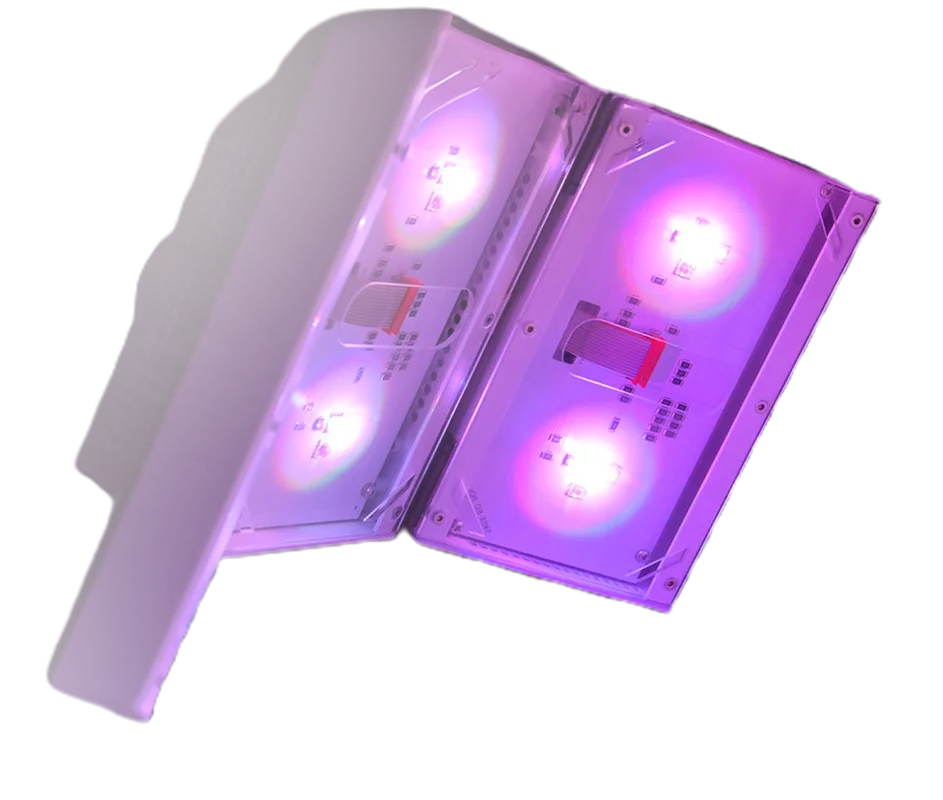
QUICK ANSWER
Red light therapy and photobiomodulation (PBM) are not competing technologies — red light can be one way of delivering PBM. The key difference is how the light is delivered: PBM is defined by controlled parameters — including wavelength, irradiance, dose (fluence), pulse structure and exposure time — rather than by color alone. ATP38 applies this parameter-controlled approach across six wavelength bands characterized in peer-reviewed research. [S1]
Red light is part of the picture
Red light typically refers to visible wavelengths in the red portion of the spectrum. In PBM research, red and near-infrared ranges are the most established, because photons in these ranges interact with cellular photoacceptors — notably cytochrome c oxidase in mitochondria — and influence cellular signaling. [S2, S3]
That makes red light a legitimate tool. What it does not make is a complete protocol: the same color of light, delivered at a different dose, distance or duration, can produce a different biological response. [S4]
What makes photobiomodulation different?
Photobiomodulation is not “using a stronger light.” It is the controlled delivery of non-thermal light using defined parameters. Reviews of the field consistently emphasize the same variables: wavelength, irradiance (mW/cm²), fluence (J/cm²), pulse structure, exposure time and treatment schedule. [S4, S5]
This is why two devices that emit a similar color cannot be assumed to deliver the same biological dose. A category label says little by itself — the parameters and the evidence behind them say almost everything.
Why multiple wavelengths?
Different wavelengths interact differently with tissue. Shorter red wavelengths are generally used for more superficial targets, while longer near-infrared wavelengths are typically selected when deeper optical penetration is desired — with the caveat that actual penetration depends on tissue properties, geometry, irradiance and distance. [S4]
Laboratory work supports wavelength-specific responses: Karu and colleagues identified action-spectrum maxima around 620, 680, 760 and 820 nm in a cellular model. [S3] For a practice, the practical consequence is flexibility: a system able to select and combine wavelength bands by protocol can address different targets within one platform.
Side by side: broad red light vs. multi-wavelength PBM
Feature
“Red light therapy” — broad market term
ATP38 multi-wavelength PBM
Spectrum
Often centered on red and, depending on the device, near-infrared. Exact wavelengths vary by product.
Six measured emission peaks: 454, 525, 594, 627, 729 and 842 nm. [S1]
Scientific framework
Can be delivered as PBM when light is used non-thermally with defined treatment parameters.
Studied as a multi-LED PBM system with wavelength-specific dosing and delivery protocols. [S1]
Dosimetry
Varies substantially by device; meaningful comparison requires irradiance, fluence, distance and time — not just color.
Manufacturer-defined protocols specify wavelength, dose (0.8–4 J/cm²) and pulsed or continuous delivery. [S1]
Depth / target
Penetration depends on wavelength and tissue properties; red and NIR behave differently. [S4]
Visible-through-near-infrared range, with spectral bands selected and combined by protocol. [S1, S7]
Professional selection
Device quality and intended use vary widely; compare technical parameters and evidence rather than category labels.
Professional multi-panel system with public, peer-reviewed technical characterization. [S1]
How the ATP38 approaches PBM
A 2026 peer-reviewed radiometric and spectral characterization, published in the Journal of Biomedical Optics, measured the ATP38’s output directly — identifying six emission peaks and evaluating manufacturer-defined protocols with wavelength-specific light doses from 0.8 to 4 J/cm², delivered in pulsed (5 Hz, 70 Hz) or continuous-wave modes. [S1]
Taken together, the public evidence supports positioning the ATP38 as a multi-wavelength, parameter-controlled PBM platform — a different proposition from a conventional single-band red-light panel. A buyer does not have to rely on marketing claims: the device’s spectral and radiometric behavior is documented in peer-reviewed literature. [S1]
SIX MEASURED EMISSION PEAKS [S1]
454 nm
525 nm
594 nm
627 nm
729 nm
842 nm
Irradiance characterized at a 4 cm working distance in the 2026 study. Spectrum per the manufacturer: 450–835 nm, software-controlled selection and combination. [S1, S7]
Why dosimetry matters
In PBM, more energy is not automatically better. The research literature describes a biphasic dose-response: a dose that is too low may not stimulate a measurable response, and a dose well above the effective window can reduce or even inhibit it. [S5]
Controlled dosimetry — knowing the wavelength, irradiance, fluence, time and delivery mode actually reaching the tissue — is therefore a core requirement for professional use, and a key question to put to any device supplier. [S4, S5]
What to compare when choosing a professional PBM device
Whether a product is marketed as “red light therapy” or “photobiomodulation,” the evaluation checklist for a practice is the same:
-
Which wavelengths are actually emitted — and are their spectral and radiometric characteristics supported by reliable technical or peer-reviewed documentation?
-
Are irradiance and fluence reported clearly, at a stated working distance?
-
Can wavelength and delivery mode be controlled by protocol?
-
Is the treatment field appropriate for your clinical workflow?
-
Is there peer-reviewed technical or clinical evidence for the device or its treatment parameters?
-
What training, support and protocol guidance come with the system?
Frequently asked questions
Is red light therapy the same as photobiomodulation?
Red light therapy can be a form of photobiomodulation when red light is delivered non-thermally using controlled treatment parameters. PBM is the broader scientific framework and may also include near-infrared and other selected wavelengths, depending on the device and protocol.
What wavelengths are commonly used in photobiomodulation?
Red and near-infrared wavelengths are the most established ranges in the PBM literature. Specific devices may add other visible wavelengths when supported by their design and protocols.
Why does wavelength matter in PBM?
Wavelength affects optical absorption and penetration, while the biological response also depends on irradiance, fluence, pulse structure, exposure time and tissue characteristics.
Why does dosimetry matter?
PBM response is dose-dependent. Research describes a biphasic response, so effective treatment is not a matter of using the highest possible power or the longest exposure.
How is the ATP38 different from a conventional red-light device?
The ATP38 is a multi-LED PBM system with six wavelength bands characterized in peer-reviewed research, along with manufacturer-defined, wavelength-specific protocols. A 2026 peer-reviewed study directly characterized the system’s spectral and radiometric output. [S1]
See multi-wavelength PBM in practice
Explore the ATP38’s specifications and clinical applications — or talk to a BioLights specialist about how parameter-controlled PBM fits your practice.
References
- Gerelli E., Wagnières G., Joniová J. Radiometric and spectral characterization of multipanel planar light-emitting devices. J Biomed Opt, 2026. PubMed · Full text [S1]
- Photobiomodulation CME Part I: Overview and Mechanism of Action. J Am Acad Dermatol. PubMed [S2]
- Karu T.I. et al. Photobiological modulation of cell attachment via cytochrome c oxidase. PubMed [S3]
- Zein R., Selting W., Hamblin M.R. Review of light parameters and photobiomodulation efficacy. PubMed [S4]
- Huang Y.Y. et al. Biphasic dose response in low level light therapy — an update. PubMed [S5]
- Photobiomodulation: lasers vs. light emitting diodes? PubMed [S6]
- Swiss Bio Inov — ATP38 technology page. atp38.com [S7]